Living Egypt & Hinduism
Creation
The universe starts from a single, powerful source.
Creation happens when that source releases its own primal energy (like a seed or a spark) into a receptive space (like a hand or a womb). The power is in the seed; the fisj, the act of receiving starts everything.
The Act of Creation of Atum and Khepri.
The sun god Atum brings the first differentiated beings, Shu, Air and Tefnut, moisture. Which can be an act of autofellatio or masturbation. The emission (a masculine, active principle) must be caught, held, and given a medium—a function associated with the hand of God or the Divine Feminine.
In Hinduism, this idea is symbolized by the Siva Lingam.
The lingam (the pillar) represents Siva—the pure, unformed source of all potential energy. It’s like the divine seed or the first beam of light.
The yoni, the Divine Feminine, represents Sakti—the active, creative power that receives that energy and shapes it into the world.
Together, they show that creation needs two: the potential (seed/light) and the power to manifest it (the vessel).
Egypt: Atum (source) → Seed → Hand (receiver) = Creation.
Hinduism: Siva (source) → Lingam (seed/light) → Yoni (receiver) = Creation by Sakti.
The two of the them are about the sacred, first spark from which everything grows.
If we take away the literal sexual act, the story becomes a metaphor for the unique creative powers that masculine and feminine principles bring into partnership.
It has nothing to do with biological men and women, it's about two universal kinds of energy that exist in everyone and in nature. In partnership, they create something greater than themselves.
The power they have separately is incomplete.
The power they have together is creation itself.
Together, they create:
A Child
A Work of Art
A Society
A Relationshjip
A Wisj coming to Fruition.
Creation happens at the meeting point of Potential and Form, Idea and Embodiment, Giving and Receiving.
Life and all creation emerge from the sacred collaboration of two complementary forces.
Men and women carry these principles inside of them and have the power to complete a cosmic circuit.
One provides the seed of the future - air - the other provides, grounds the wisj into reality. He gives the world Asera for it to grow in. He nurtures. Alone, they are potential. Together, they are creation.


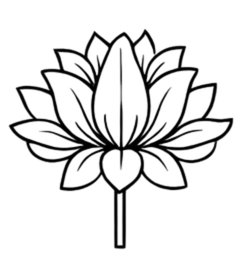
Lotus
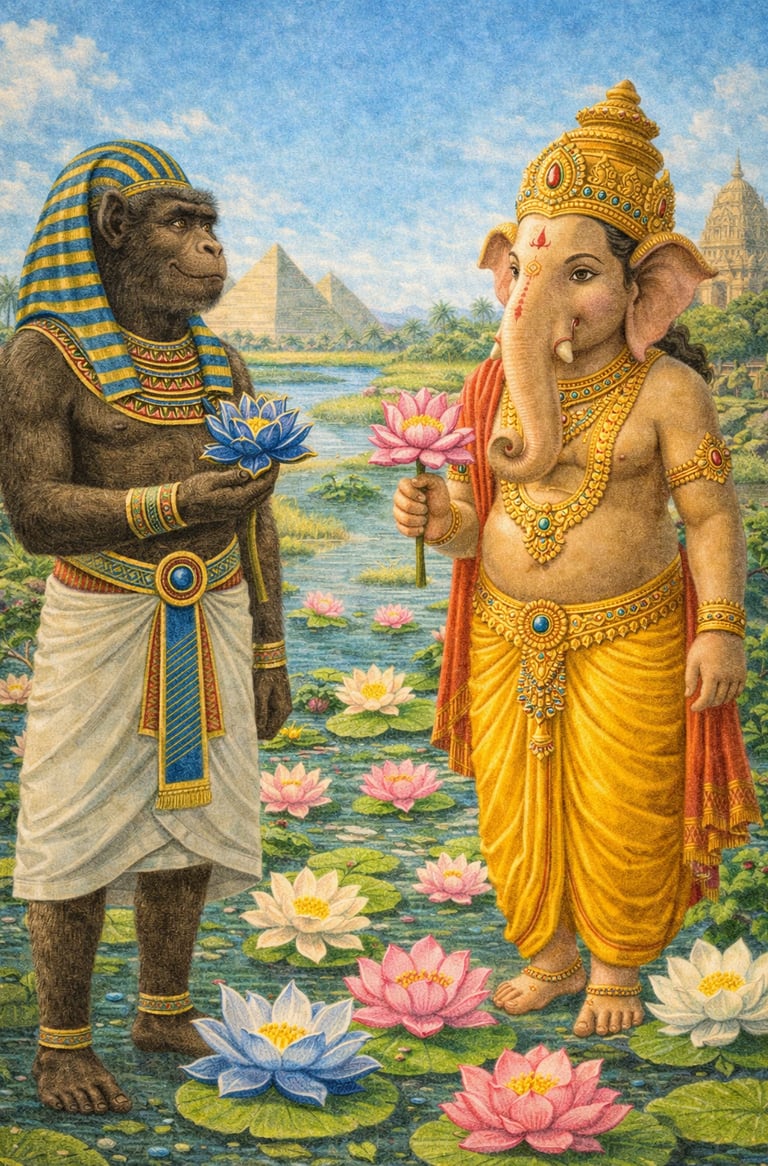
The lotus is the Ancient Egyptian symbol of creation, the Sun, and being born again.
The blue and white lotus flower, specifically the blue lotus, are a symbol of creation and the farm of the world.
The lotus’s daily cycle—submerging at night and rising anew each morning to bloom on the water’s surface—made it the perfect symbol for creation itself.
The lotus represents the moment of cosmic order -Ma’at - arising from the void.
The Sun god Ra was sometimes depicted as a child sitting atop a lotus.
The lotus symbolises the promise of being born again in the afterlife. The flower is also used in religious ceremonies to induce a conducive state to communicate with the divine.
The sacred blue lotus' color is connected to the primeval waters (Nun) and the heavens.
The lotus is the heraldic plant of Upper Egypt, the south of love, and the papyrus represents Lower Egypt, the north of air. Together, they symbolise the unity of the Two Lands.
The lotus is the Sun's cradle, the Farao's promise, the land's unity.
In Hinduism, the lotus is a symbol of purity, enlightenment, and divine manifestation
The lotus (padma or kamala) is one of the most sacred and pervasive symbols, representing spiritual awakening, divine beauty, and transcendent purity.
The lotus grows in muddy, stagnant water, yet emerges immaculate and beautiful. This mirrors the spiritual journey.
The universe is pictured as a 1000-petaled lotus unfolding from the navel of Visnu as he rests on the cosmic serpent Shesha in the primordial ocean. The creator god Brahma is born from the lotus that emerges from Visnu’s navel.
Nearly every major Hindu deity is associated with the lotus, either seated upon it, holding it, or wearing it, symbolizing divine grace blossoming from the cosmic waters. Saraswati's wiite lotus brings wisdom free from ignorance.
The chakras - energy centers in the subtle body - are visualized as lotuses with varying numbers of petals:
Muladara - Root - 4 petals
Svadistana - Sacral - 6 petals
Manipura - Solar Plexus - 10 petals
Anahata - Heart - 12 petals
Visudda - Throat - 16 petals
Ajna - 3rd Eye - 2 petals, sometimes depicted as a white lotus.
Sahasrara - Crown - 1,000-petaled lotus, the seat of supreme consciousness and union with the divine.
Each petal corresponds to a sound (bija mantra) and a psychic channel (nadi).
The Hindu lotus is a map of spiritual ascent.
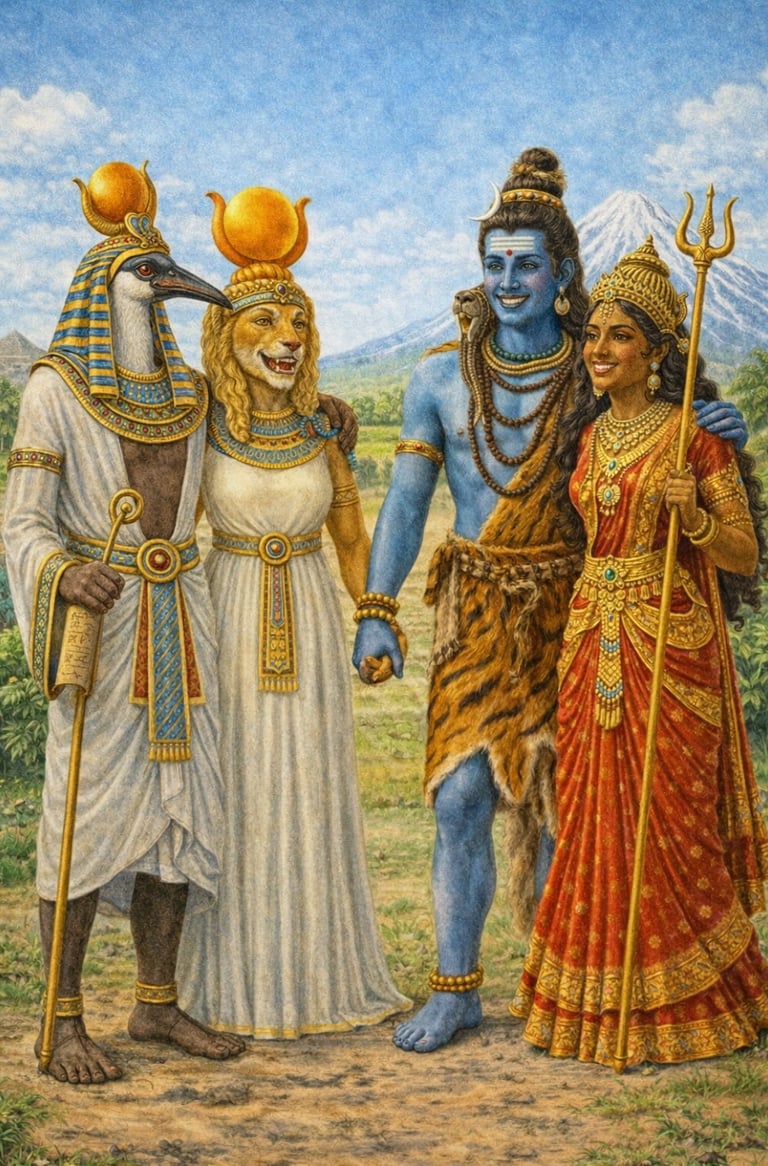
Egyptian and Hinduism celebrate the lotus for being born again and purity, Their stories give a different piece of the pie.
Egypt: Focus on solar, cyclical being born again—the lotus as the Sun rising from primordial waters.
Hinduism: Focus on spiritual revelations and following your heart. The lotus as the soul rising from worldly illusion to divine true knowing. Being born again is an inward journey of consciousness shedding illusion. Your ticket out of the box.
The message stays the same.
You are the flower. Awaken.
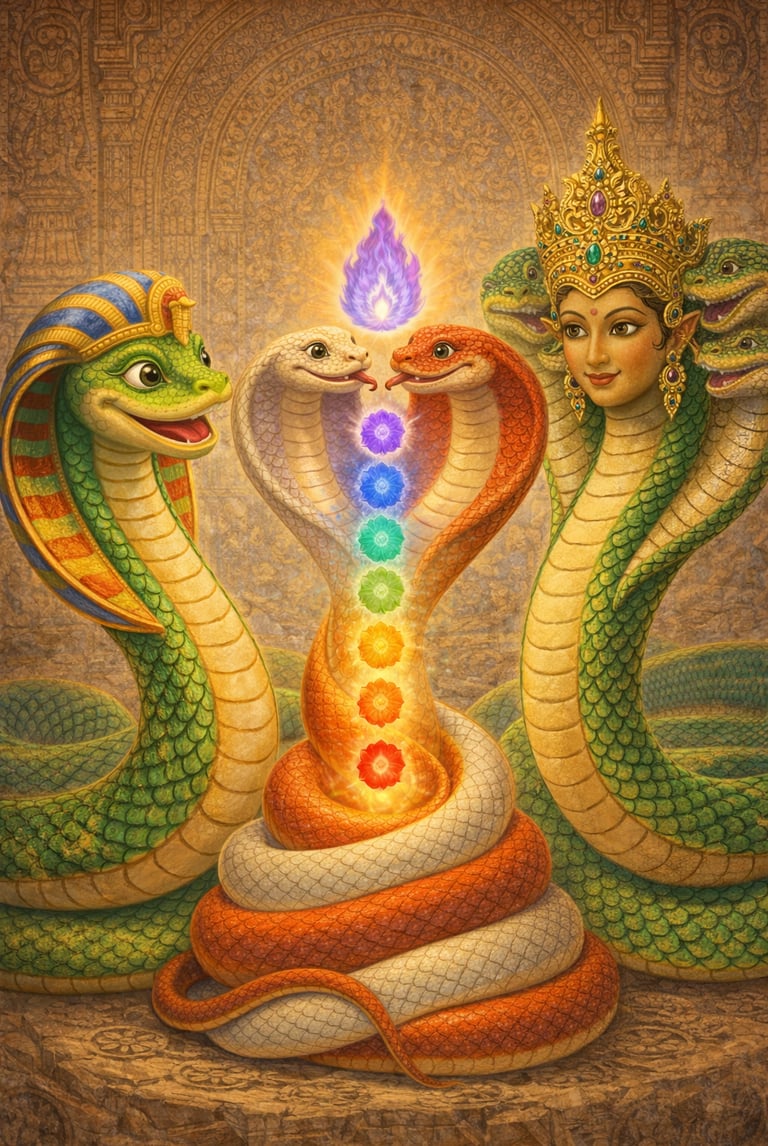
The Serpent - Wadjet - Kundalini
The Faraos crown shows the Uraeus - the cobra, worn on the forehead. It is a symbol of sovereignty, protection, and divine authority.
It is seen as the Eye of Ra, a fierce protector who also represents the goddess Wadjet, the protector of Lower Egypt.
In Hinduism the serpent Nāga is revered the same as in Living Egypt and represents everything from primordial life force to divine protection, and cosmic energy. The infinite, 1000-headed serpent floats on the cosmic ocean and serves as the bed and canopy for Lord Visnu, the Preserver. The nāga represents eternal life and a supportive foundation of the universe.
The dormant Kundalini of the goddess Sakti is depicted as a female serpent coiled 3 and a half times around the Svayambhu linga at the base of the spine - Muladara chakra.
The Kundalini activates when the soul follows their heart and acts in accordance with Divine Will, leading to spiritual enlightenment and union with the divine at the crown of the head.
The awakening of supreme consciousness requires traversing unknown territories, with graceful and challenging periods that initiate and activate transformation.
The wisdom of Egypt and Hinduism holds the same knowledge. The snake is a symbol for the lived experience of being born again and again. One has gained mastery by shedding limiting societal beliefs and learning their soul's life lessons.
The snake is a symbol sent by the Sun, seeing it, means you have done profound inner work and your healing abilities have been activated.
Blue Divinity
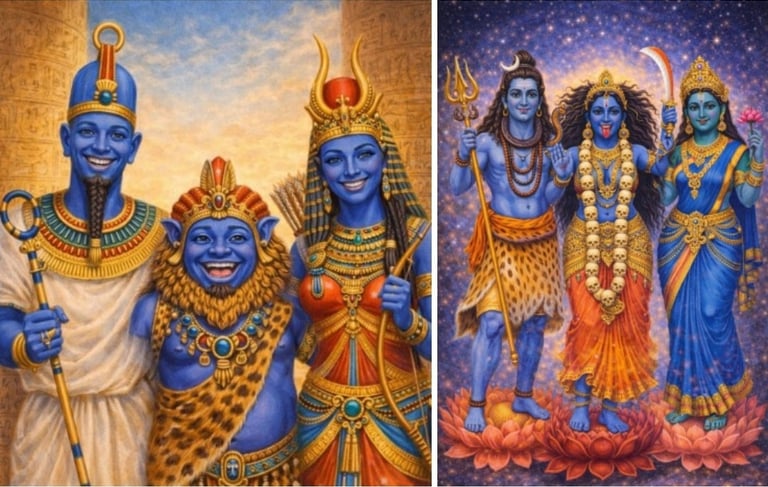
Egyptians and Hindus use the color blue to symbolize the most profound, life-giving, and transcendent aspects of the divine. A sacred code.
The Unified Insight:
The two civilizations identify blue as the color of the source. For the Egyptians, it is the fysical source—the water and fertile land from which their world literally springs. For Hindus, it is the metafysical source—the infinite spiritual reality from which the universe emanates.
Egyptian blue is the sacred color of the World's Womb; Hindu blue is the sacred color of the Cosmic Canvas.
"Where does it all come from?"
One points to the water of the Nile, the other to the cosmic ocean. Egyptians and Hindus reside in the waters of Asera. Love.
Panonpoe asli!